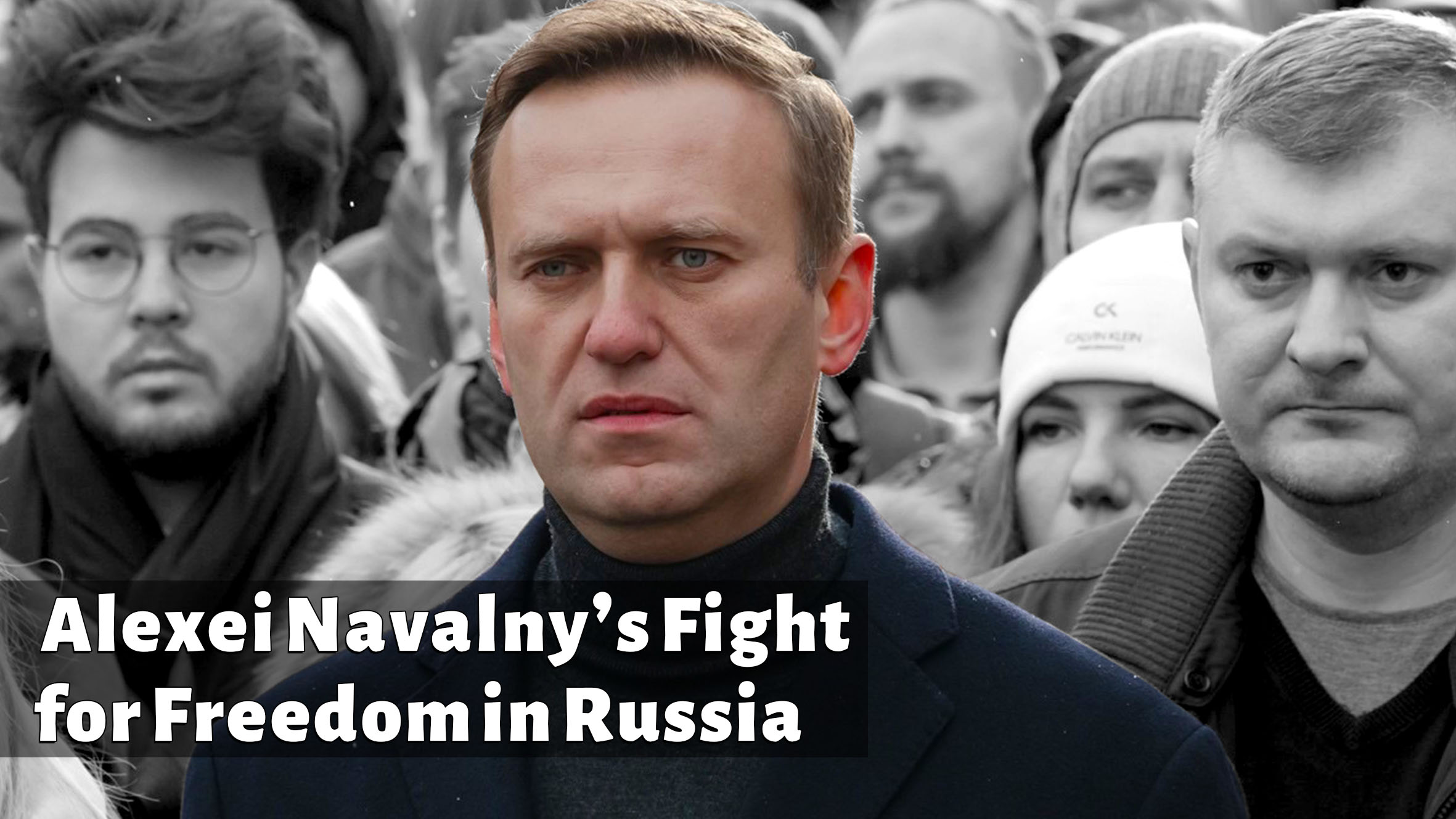
The outcome was preordained: Alexei Navalny knew that as soon as he returned to Russia, he would be arrested. He also knew he would face brutal conditions inside a Russian prison – and all of this after a world-famous attempt by the Russian government to assassinate him in 2020. It had taken him months in Germany just to regain the ability to speak, to write, and to coordinate his movements. But there was no question in his mind: “Of course I’m going back. If I don’t, that will be the ideal outcome for them. They’d love to have me as just another political émigré.”[1]
Despite authoritarian regimes’ relentless efforts to silence dissent, some individuals remain steadfast in their bravery, willing to sacrifice personal safety to uphold their principles. Alexei Navalny was one such figure. The Kremlin did everything it could to stop him — from imprisoning him to attempting assassination — yet his commitment to justice and opposition to Russia’s undemocratic regime never wavered. Even with the choice to remain safely abroad after a near-fatal poisoning in 2020, he returned to Russia, fully aware that arrest and brutal treatment awaited him. He famously declared, “Of course I’m going back. If I don’t, that will be the ideal outcome for them.” Navalny’s return was a powerful statement of defiance, underscoring that he refused to be silenced or reduced to just another political exile. His life and tragic death are reminders of the courage it takes to stand against oppression and the enduring impact of such resistance.
Defiance in the Face of Imprisonment – Navalny Returns
On January 17, 2021, Navalny had made good on his promise and went back home, where thousands of supporters awaited him. In a Moscow airport, he declared, “I am not afraid…because I know that I’m right. I know that the criminal charges against me are falsified. And all these efforts to scare me—I don’t just have the truth on my side, I have the courts on my side. They are threatening to arrest me in connection with a case on which the European Court has ruled in my favor. So I’m not afraid of anything, and you shouldn’t be afraid of anything, either.”[2]
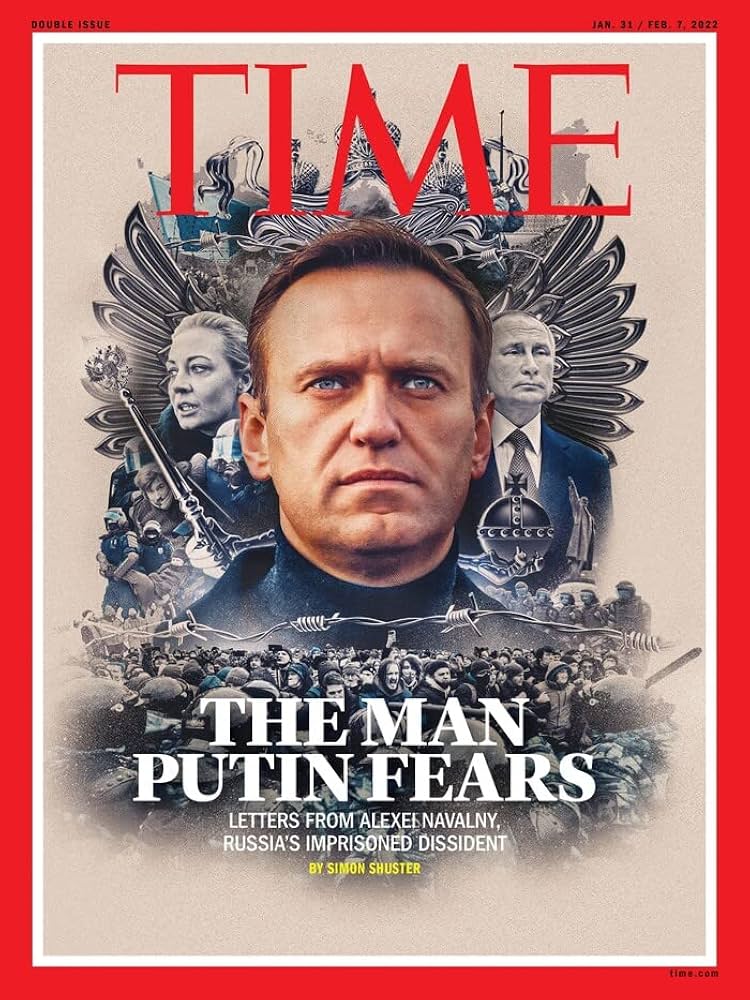
By this point, Navalny had spent decades making himself into the most persistent thorn in Russian President Vladimir Putin’s side. Starting with a blog documenting government corruption, Navalny had gradually attracted an audience of thousands, then millions. His Anti-Corruption Foundation had made world headlines with its exposés of government abuses of power. He had also built a political infrastructure that attracted and mobilized hundreds of thousands of supporters across the country – enough to frighten the Kremlin.
Years of trumped-up political charges and sham trials had not silenced him, any more than security services’ assassination attempt would. Even while serving a nine-year sentence in maximum-security prison, Navalny continued to speak out: “The Putin regime is an historical accident, not an inevitability…Sooner or later, this mistake will be fixed and Russia will move on to a democratic, European path of development. Simply because that is what the people want.”[3]
The 1990s and 2000s: The roots of autocracy and activism
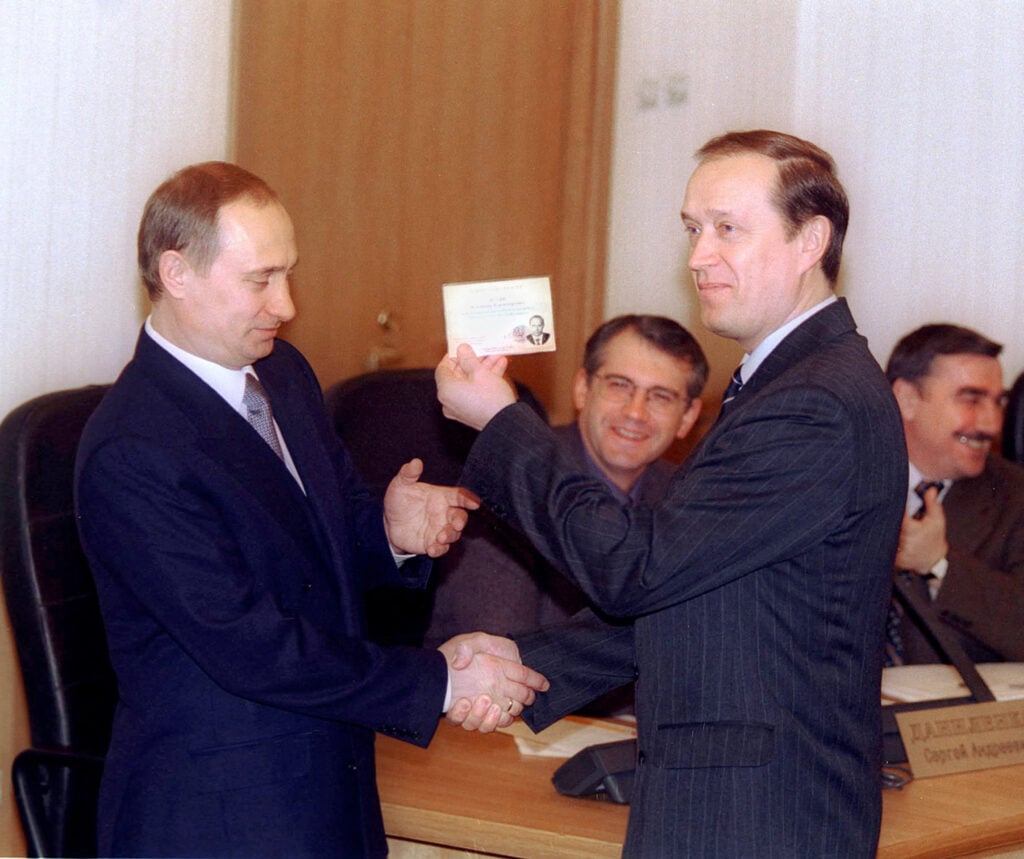
Born in 1976 in a village west of Moscow, Navalny was cynical about the Soviet regime from an early age, identifying as a liberal and supporting the reforms instituted by Boris Yeltsin, the first president of Russia after the Soviet Union’s collapse in 1991.[4] Navalny was not the only one who hoped for democratic transition in the 1990s – but despite a range of promising steps, such as free and fair parliamentary elections, a free press and a variety of political parties, the government also sowed the seeds that would later grow into a new autocracy. It established a “super presidential” system that concentrated power in the presidency; failed to dissolve or reform the famously repressive KGB security agency; and allowed corruption to flourish. Perhaps the most fateful turning point into a regression to autocracy came in 1999, when President Boris Yeltsin selected the former KGB agent Vladimir Putin as his successor, perhaps under the impression he would not disturb the status quo.[5]
After his 2000 election, Putin swiftly moved to consolidate power. He seized control of national television to skew media coverage of his administration, removed governors from the parliamentary upper house, created new “super regions” headed by Kremlin appointees, and shifted the composition of government to include more and more personnel from the security and military sectors.[6] Despite these steps, Putin refrained from a total crackdown on dissent, buoyed by widespread popularity due to economic growth.[7] Confined by term limits, he allowed his loyal aide, Dmitri Medvedev, to assume the presidency in 2008; during the following four years, Medvedev implemented modest reforms and allowed space for dissent.
It was in this repressive, but not totalitarian, context that Navalny began to delve into politics. After launching his career as a lawyer, he joined the liberal Yabloko party, saying that “it was the only consistent democratic party that spoke about ideas and did not trade them for money, political appointments, or [presidential] posts.”[8] He gradually became engaged in party leadership in Moscow in the early 2000s and even became the executive secretary of a committee focusing on illegal construction projects in Moscow.
With powerful political and media forces arrayed against them, Yabloko and Navalny struggled to make an impact. But even as Navalny had recognized the limitations of traditional party politics, he was also skeptical of the ability of activists to make a difference. In fact, when called on to support an environmental campaign to save Khimki Forest, near Moscow, from partial destruction to build a highway, “I was one of those people who thought that it was senseless to get involved. I told them to forget about it, not to bother. But they achieved things that no one had thought possible. I was inspired.”[9] (After years of protests, Medvedev called off the Khimki construction project in 2010.)
Meanwhile, Navalny had started making investments in Russian companies; although his initial intention was merely to make money, as he read reports and followed the news about the companies he had shares in, he “was horrified. At that time, there was still no [global financial] crisis, oil prices were breaking all records, and the companies in which I held shares were ‘chocolate covered,’ but the companies’ reports said: There will be no dividends…I decided to figure out where the companies’ profits go and why they don’t share them with me.”[10] As he kept going, “it became a matter of principle.”[11]
The online battle against corruption in Russia
Navalny turned his attention to corruption, viewing it as “a matter of justice” for Russians whose government is stealing from them. “What’s happening to our country,” he said, “is like some old, feeble woman being mugged by a gang of evil teenagers as she walks down the road. But, instead of helping her out, everyone just watches.”[12] Navalny realized that the innocuous blog he had started in 2006 on Livejournal could become a critical tool to fight corruption and help his country.
Corruption has been endemic in Russia for hundreds of years, but it shot up during the 1990s as the post-Soviet economic transition opened up new opportunities for corrupt relations between the government and business. Today, bribery is widespread across a variety of sectors, from law enforcement to education. “The most horrible thing,” one Russian says, “it is absolutely normal.”[13] In government procurement, corruption exists on an even more massive scale; some estimates have found that the cost of public procurement corruption is equivalent to about a third of Russia’s federal budget.[14]
Russians have paid with their lives for the bribes that led officials to turn a blind eye to unsafe conditions: 156 dead in a 2009 nightclub fire in Perm, 129 dead in a 2011 riverboat sinking in Moscow, and hundreds of coal miners killed in Siberia over the years from fires caused by high levels of methane gas. Likewise, bribery of security officials has cleared the way for terrorist attacks. In 2004, 89 people were killed in suicide bombings on planes after airport personnel took under US$200 in bribes to let the terrorists on board – and just a month later, Chechen fighters used bribes to get through dozens of checkpoints on the way to hold over 1,000 people hostage at a school in Beslan.[15] Ultimately, over 300 people were killed, including 186 children, in Russia’s deadliest terrorist attack ever.
Repercussions for those fighting against corruption could be severe. In 2008, after the journalist Mikhail Beketov covered the planned Khimki Forest highway and the opposition to it, two men smashed his hands, legs, and head with an iron bar; he spent the rest of his life in a wheelchair, unable to speak. That same year, when the lawyer Sergei Magnitsky discovered embezzlement by Interior Ministry officials, he was arrested and tortured in jail, where he died in 2009 at the age of 37.
Navalny, however, was determined to press on, using his blog to shine a spotlight on corruption. “Censorship was the reason I gradually got involved in writing this blog,” Navalny explained. “There was no other way. Blogs of a similar format are not popular abroad because this kind of information gets published in the press there. But here, all we can do is write blogs…First, my acquaintances started following me on Livejournal — political journalists, activists, et al…Over time my blog has become a real media outlet.”[16]
Navalny’s investments in Russian companies enabled him to obtain confidential information on company activities and attend shareholder meetings, where he could confront company management with bold questions face-to-face. In April 2008, for example, he had joined the oil company Surgutneftegaz’s annual shareholder meeting, taking the mic to ask who owned the company, why its dividend yield was so low, and why it was so difficult to access information on the company.[17]
Just as important as obtaining this information was making it known to the public. Company by company, he had dug into records, filed complaints – and published all he uncovered on Livejournal, where his posts attracted a growing audience and prompted mainstream media coverage. In 2010, he broke his most explosive story yet, accusing the Transneft oil transport monopoly of stealing $4 billion in state funds during the construction of a massive East Siberia-Pacific Ocean pipeline. “This is not my report,” he declared. “This is not the opinion of analysts or experts. This is official Transneft material, prepared and signed by dozens of its employees…Our hair stood up on end when we read this report. It says that billions of dollars were stolen – simply stolen – during the realization of this wonderful national project.”[18]
In December 2010, Navalny launched a new website, RosPil, designed to use crowd-sourcing to uncover corruption in government procurement. Navalny’s followers used publicly available information to investigate fraud such as the thirty gold and diamond wristwatches a regional governor ordered as “gifts for local teachers,” or a $276,000 Audi ordered by a regional finance minister.[19] This enthusiastic community also flooded the Federal Anti-Monopoly Agency with complaints, resulting in the cancellation of many tenders – nearly US$7 million worth of them within under four months, according to RosPil records.[20] By “poking [corrupt institutions] with a sharp stick,” as he put it, Navalny had gradually achieved not just a national profile but an international one as well.
2011-2012: Rigged elections and mass protests
2011 would be a turning point for Russia, one way or another. Approval ratings for Putin’s party, United Russia, were on a downward slide in the wake of the 2008 global financial crisis. Parliamentary elections were scheduled for December, and the next year would bring presidential elections. Perhaps Russia might finally see real change and move towards greater liberalism and democracy – or perhaps it might sink deeper into authoritarianism.
As the country geared up for elections, the “Arab spring” of protests against repressive governments broke out in the Middle East. While the uprisings inspired Navalny, they only stoked Putin’s fear of populist rebellions and strengthened his belief that an iron grip would be necessary to hold onto power. In September, he and Medvedev announced that Putin would seek the presidency in 2012, simultaneously dashing the hopes of the Russian opposition and energizing their movement.
Navalny set about to do all he could to decimate United Russia’s approval ratings so that they would fail at the polls. Early in the year, in a comment in passing on a radio interview, he had branded United Russia a “party of crooks and thieves,” and the label caught on quickly. It appeared on stickers all over Moscow in the weeks leading up to the elections, as Navalny called on Russians to vote for “any party but United Russia.”[21]
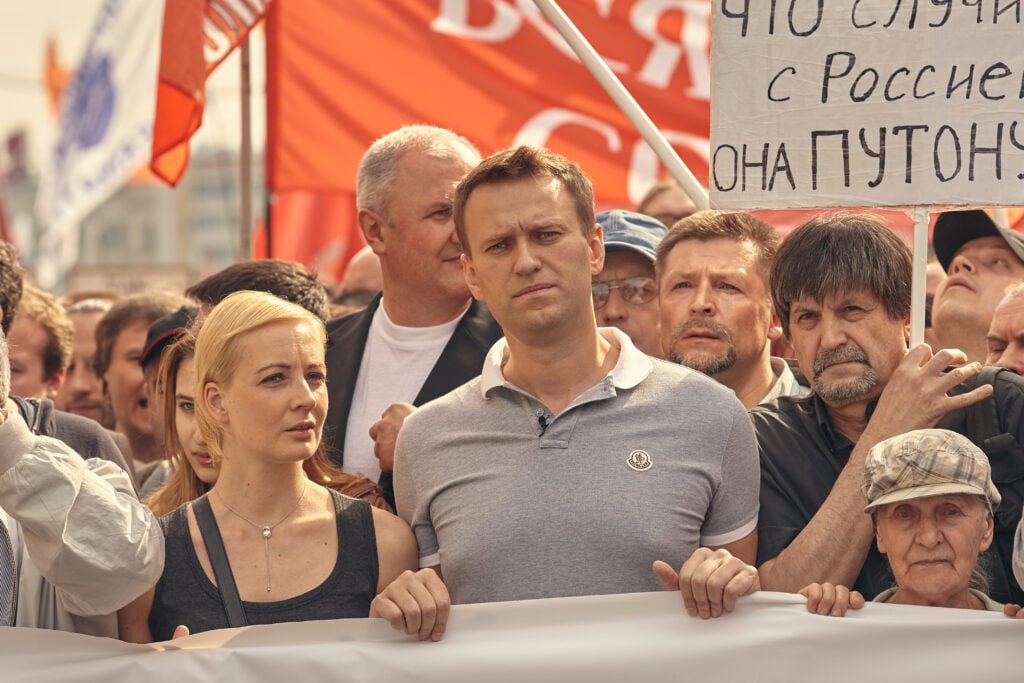
After votes were tallied on December 4, even though the party’s share of the vote slipped below 50 percent, it still kept its parliamentary majority – albeit with widespread irregularities. As documentation of electoral fraud spread across social media, protests broke out, with Navalny addressing the crowds in Moscow for the first time in his life: “I see enough people here to take the Kremlin right now! But we’re a peaceful force; we won’t do that – yet. But if these crooks and thieves try again to trick and lie to us, we will take it! It’s ours.”[22] He seemed optimistic that the regime might reform, if only for its own survival.
The protests were met with regime-organized counter-protests, arrests (including of Navalny), and promises of political reforms from Medvedev. Exciting as the demonstrations were in their representation of moderates and radicals, the left and the right, nationalists and liberals, their diversity came with a lack of coordination and unity. As one Soviet-era dissident put it, “We shared certain values on the importance of human rights, but the values of the people protesting today sometimes contradict each other so much that it’s hard to even see a common link between them.”[23]
As the protests petered out, the presidential election got underway, and despite widespread dissatisfaction with conditions in Russia, the reality was that Putin remained the country’s most popular politician. Not only did many Russians place blame on lower levels of government – “a classic case of ‘good tsar, bad boyars’” – there also seemed to be no viable alternative to Putin.[24] Despite Navalny’s rising profile, in March 2012 his nationwide name recognition stood at just 25%.[25]
After Putin announced victory in the March 2012 presidential election, protests were soon squelched by violence and mass arrests. Although previous protestors had only been arrested for a short time, then released, this time, they faced criminal prosecution – a warning to Russians to stay away from protests. Over two dozen people were sentenced to multiple-year prison terms in an ominous sign for civil liberties under Putin.[26]
The 2010s: Navalny in politics
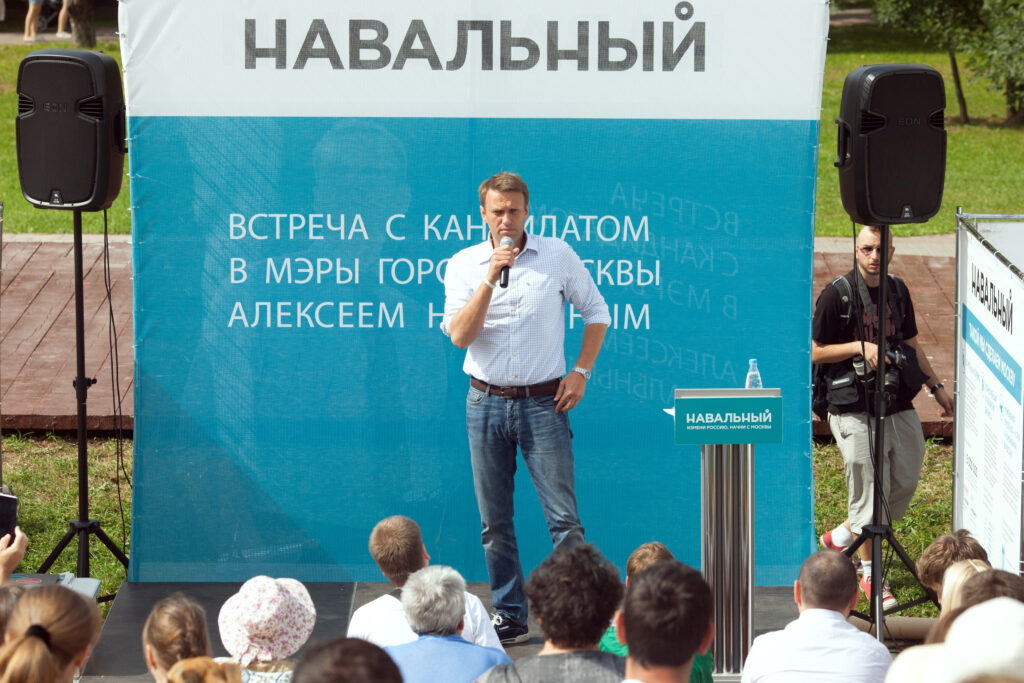
Under Putin’s new regime, Navalny was to face a growing array of legal threats. Charges from 2010 that he had embezzled funds from the Kirovles timber company, which had been dropped in 2012 due to a lack of evidence, were revived. Navalny also faced accusations of defrauding a liberal political party, even though the party’s leaders said no money had gone missing. In 2014, both Navalny and his brother were accused of defrauding the Yves Rocher cosmetics company, despite the company’s protests that no such thing had happened. As Navalny battled these charges, he took the leap into electoral politics. Medvedev had promised that regional heads would again be elected, beginning in Moscow, and Navalny joined the mayoral race in 2013.
Of course, the day after he was registered as a candidate, he was convicted on the Kirovles charges and sentenced to five years in prison, which disqualified him from running. However, the Kremlin actually wanted Navalny in the race, in order to present a façade of democracy to the world while still ensuring Navalny lost. When Navalny appealed his conviction, he was released, allowing him to embark on an enthusiastic campaign. Thousands of volunteers distributed leaflets across Moscow as Navalny announced a platform that encompassed democracy, transparency, and a strict stance towards immigration.
Navalny’s position on immigration was rooted in his longstanding nationalist inclinations. In 2007, after leaving Yabloko, he had co-founded a short-lived party, NAROD, that attempted to “create a fusion of liberalism and nationalism – a creed that could unite the majority of the population against the Putin regime.”[27] According to Navalny, illegal immigration in Russia was rampant, and Kazakh, Kyrgyz, Uzbek, and Tajik citizens – who could enter Russia without a visa and then overstay – ought to be required to obtain visas.
His rhetoric at the time could be disturbing. In one video filmed for NAROD, Navalny declared, “We have the right to be [ethnic] Russians in Russia, and we’ll defend that right.” In another video, he asked what should be done with a cockroach that is too aggressive or big – while showing Chechen terrorists on screen. His proposed solution? “I recommend using a handgun.”[28]
Over time, he modulated his positions on immigration, apologizing for his previous rhetoric and continuing to support a visa system while emphasizing the need to protect migrant workers’ rights. He also advocated for communicating with nationalists and educating them. He said, “I think it’s extremely important to explain to them that beating up migrants is not the solution to the problem of illegal immigration; the solution is a return to competitive elections that would allow us to get rid of the thieves and crooks who are getting rich off of illegal immigration.”[29]
Similarly, Over the years, Navalny’s stance on Russia’s relations with its neighbors evolved significantly. When Russia invaded Georgia in 2008, Navalny had called Georgians “rodents,” saying he would like to launch a missile at Georgian military leaders and comparing the Georgian prime minister to Adolf Hitler.[30] Although he later apologized for his rhetoric, he did not waver in his support for the war on Georgia.[31] Later, in 2014, he refused to unequivocally oppose Russia’s illegal annexation of Crimea, saying the peninsula was “de facto Russian” and asking, “Is Crimea a sandwich or something you can take and give back? I don’t think so.”[32] However, after expressing opposition to Russia’s 2022 invasion of Ukraine, he ultimately denounced Russian imperialism and declared that Crimea should be returned to Ukraine.
As far as the 2013 Moscow mayoral race went, although Navalny predictably lost with 27 percent of the vote, he nearly forced the incumbent into a run-off. This was a triumph for him and a humiliation for the mayor. Not only that, by now Navalny’s name recognition had reached over 50 percent.[33] He went on to announce that he would run in the 2018 presidential elections – “to transform a procedure that for twenty years has been meaningless into a real confrontation of ideas, programs, approaches, and campaigns. And I want to be your voice, your representative in this election. A real politician, connected with people, representing their interests.”[34]
On a platform that focused on socioeconomic inequality and injustice, while de-emphasizing nationalism, Navalny’s campaign worked to attract and mobilize supporters via social media, street protests, and the launch of local campaign offices countrywide. In a democratic country, this would have been par for the course, but in Russia, building a political infrastructure independent of the Kremlin was a monumental task indeed.
On multiple social media platforms, from Instagram to Twitter and YouTube, Navalny and his team used a humorous and engaging style to grab Russians’ attention. As he put it, “I’m trying to do this in an entertaining format. I’m trying to prove to everyone that the fight against the regime is fun.”[35] In 2017, he launched “Don’t Call Him Dimon,” a new YouTube exposé accusing Medvedev of corruption. It quickly went viral, reaching millions of views within a week. His team then organized demonstrations, framing them not as campaign rallies for Navalny but rather as protests against corruption among the elites. They attracted crowds in 97 cities, then an unprecedented 154 – the broadest wave of protests in Russia since at least 2012.[36]
Through strong branding, unified messaging, and tapping into local resources and activist networks, Navalny built a highly organized political movement. “For the first time in recent Russian history,” he announced, “we have created a real, massive political structure, whose basis is made up of headquarters in 83 cities and almost 200,000 volunteers across the whole country.”[37] But Putin was determined to prevent Navalny from humiliating him as he had done with the Moscow mayor in 2013. The Kirovles case, which Navalny had taken to the European Court of Human Rights and won, was revived, and in 2017, he was given a five-year suspended prison term – which barred him from running in elections for a decade.
Nonetheless, when the sentence was handed down, Navalny stated, “Four years ago, I announced here…that we will not stop our investigative work, we will not stop our fight against corruption. We won’t stop anything. And now, with a sense of deep satisfaction, I can say that I tried to fulfill this promise. … We showed their riches, we showed how they robbed our wonderful country. I think we were very convincing in these exposés. We are involved in politics; I’m participating in elections. I have done everything that I promised here.”[38]
The 2020s: An assassination attempt, then imprisonment
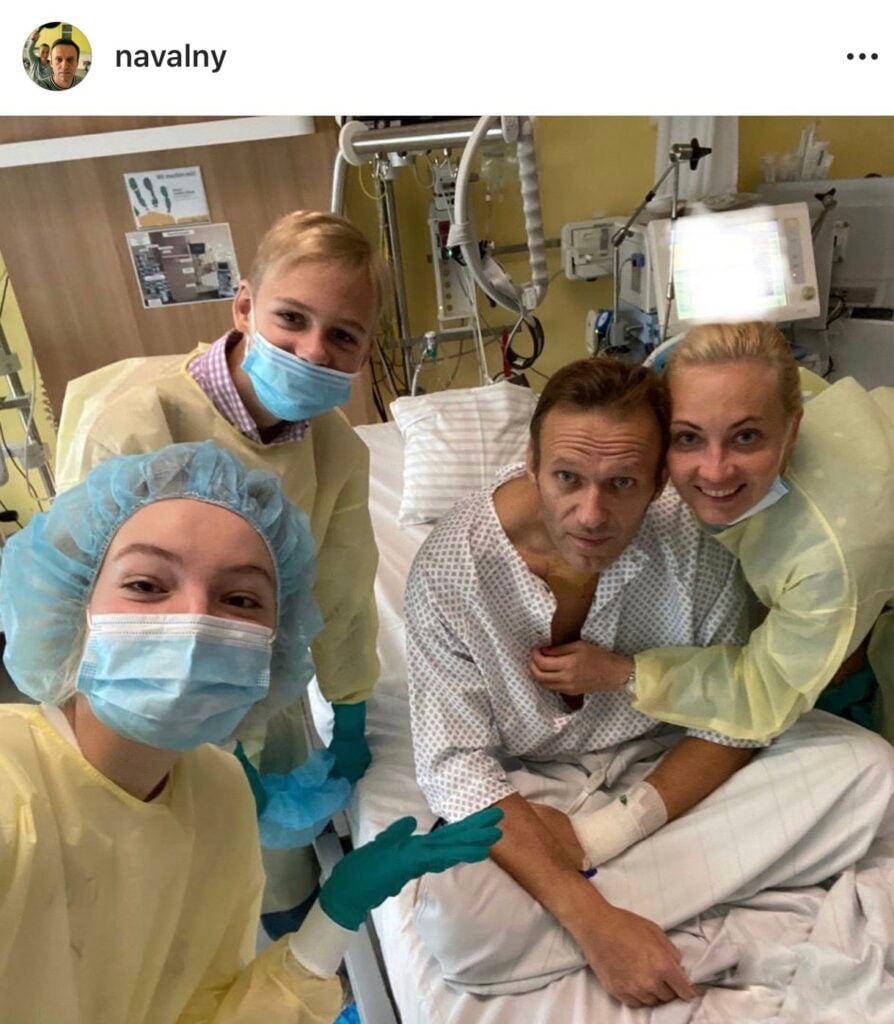
On August 20, 2020, Navalny boarded a flight from Tomsk, Siberia to Moscow. In the air, he collapsed and lost consciousness, and the flight was re-routed to Omsk for an emergency landing. Within days, a German team of medics airlifted Navalny to Berlin for treatment, where doctors concluded that he had been poisoned; according to the German government and the Organization for the Prohibition of Chemical Weapons, the assassination attempt had used a Novichok nerve agent.[39] As Navalny said, “To kill so blatantly, using Novichok – that sends a very strong message…‘He didn’t know his place, he exposed corrupt officials, he called Putin a thief – and what do you know, he is dead at 44.’”[40]
After months of recovery, Navalny did his own investigation. In December, he released a video of a phone call he allegedly made to a Russian Federal Security Service (FSB) agent in which Navalny had posed as an FSB aide. In the video, the individual on the other end of the phone line admitted an FSB team had planted poison on the seams of Navalny’s underwear, and claimed that if only the plane had not made an early landing, “everything would have ended differently.”[41]
As his convalescence drew to a close, Navalny knew that if he returned to Russia, he would surely be arrested and imprisoned. Conscious of the symbolic power of leading by example, he noted, “In people’s minds, if you left the country, that means you gave up.”[42] Upon returning to Russia in January 2021, he was immediately detained.
Just two days later, his team released a new exposé: “Putin’s Palace,” a look inside what Navalny called “the most secret and guarded facility in Russia, without exaggeration. This is not a country house, not a dacha, not a residence. This is a whole city, or rather, a kingdom.”[43] The video used drone footage, floor plans, and other documents to show viewers an elaborate complex containing everything from an underground ice palace to a luxury winery – all for Putin and all funded, according to Navalny, by “the largest bribe in history.”[44]
Though for years Navalny had investigated corruption at other levels of government, he had held back from targeting Putin himself; according to a close associate, “Alexei used to say that when we write about Putin, it will be our last investigation.”[45] He knew such an investigation would cross a red line and trigger Putin’s rage. After his assassination attempt, however, Navalny was ready to up the stakes in confronting Putin. Within a day of its release, “Putin’s Palace” had received over 20 million views, and mass protests would break out across Russia.[46]
Soon, however, Navalny was charged with violating parole by not regularly checking in with police in 2020. A prison sentence of over two years followed.[47] His Anti-Corruption Foundation was declared an extremist organization and dissolved. Still more trumped-up charges would follow in 2021 and 2022, along with a sentence to an additional nine years in prison.
Prison Conditions and Navalny’s Final Days
Navalny died on February 16, 2024, in the Arctic prison colony IK-3, in the Yamalo-Nenets region, where he had been held. According to the prison’s official statement, Navalny collapsed after a brief walk, losing consciousness almost immediately. Despite the arrival of medical staff and an ambulance team, resuscitation efforts failed. His family, including his mother, received formal notification of his death at 2:17 p.m. local time. No further details were offered by Russian authorities, other than a statement citing “sudden death syndrome,” a term often associated with unexplained cardiac events. Some sources, including Russian state media, speculated that a blood clot might have been responsible, though no official cause has been confirmed.[48]
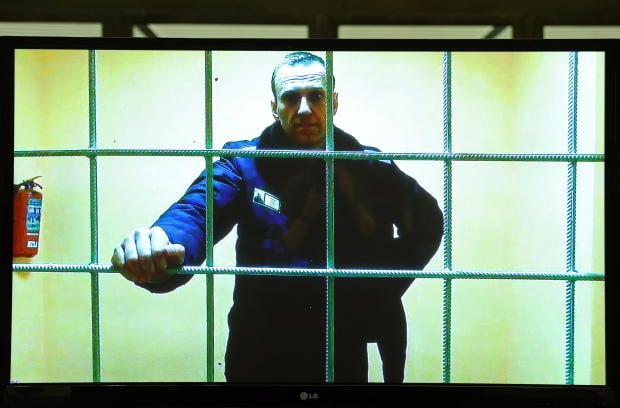
Some reports from Novaya Gazeta suggested that Navalny’s body showed bruising consistent with seizure-related injuries, possibly indicating that he experienced a severe physical episode prior to his death. An unidentified prisoner from the penal colony described an unusual increase in security activity on the evening of February 15, with guards speeding up evening checks and confiscating items from prisoners. Navalny’s legal team, family, and supporters had long voiced concern for his health and safety, with fears only heightened by the notorious conditions of the “Polar Wolf” prison, known for brutal punishment cells and extreme cold. Just a day before, Navalny had appeared via video link in a court session, joking about his financial struggles and impending solitary confinement—a routine form of punishment he endured repeatedly for minor “offenses.”[49]
While in prison, Navalny has suffered harassment and sleep deprivation, a decline in health and denial of medical care, and confinement to an isolation cell. In fact, he spent most of his time in isolation, where, in his words, “you cannot sleep properly…there is no access to prison food…and it is hard to write and read letters because of the poor lighting.” After losing 18 pounds in just two weeks, some suggested that prison officials might be “gradually killing him, using a slow-acting poison which is applied through food.”[50]
Navalny was denied family visits, a privilege that other prisoners were granted. As winter began, he was also deprived of winter clothing. As he had written before, “That means you either don’t go out for a walk (and suffer) or you go out and get sick,” a situation that inevitably led to health issues. This, in turn, gave the authorities further leverage, as “they will start to twist your arms and demand that you give up some of your positions. Prison struggle is a never-ending search for mutual vulnerabilities.” [51]
Even in death, Navalny’s calls for resistance persist. He had urged Russian voters to employ his “smart voting” strategy, which aimed to elect candidates most likely to defeat United Russia in local and national elections. He also advocated for Western nations to sanction not only low-level officials but also the oligarchs who fueled Putin’s regime, urging them to combat the “export of corruption” through measures such as the appointment of foreign leaders to corporate boards and the hybrid warfare that spreads division within Western societies, whether by manipulating migration flows in Europe or sowing discord in the U.S. [52]
Navalny also fiercely opposed Russia’s war on Ukraine, condemning it as “an unjust war of aggression.” He criticized Putin’s aspirations to “go down in history as ‘the conqueror tsar’ and ‘the collector of lands.’” In a stark departure from his previous stance on Crimea, Navalny declared that Ukraine’s borders were “internationally recognized and defined,” and that Russia, having once recognized these borders, must do so again. Rejecting the imperialistic nationalism he once championed, he argued that those with imperialistic views in Russia should be “defeated in elections” and that Russia’s true path lay in addressing its internal struggles: “Russia is a vast country with a shrinking population and dying rural areas. Imperialism and the urge to seize territory is the most harmful and destructive path.”[53]
Even as some feared the Kremlin was engaged in a “very, very slow process of murdering him again” through prolonged torture, Navalny remained defiant until his death in prison.[54] “I have a huge and rare privilege in today’s Russia,” he once said. “I say what I think is right and act as I think is necessary. Malicious Kremlin crooks have no power over me, even though they have locked me in some hole.”[55]Referencing his revision of the longstanding opposition slogan “Russia will be free,” Navalny wrote from prison to likeminded Russians in January 2023: “There are plenty of us, certainly more than corrupt judges, lying propagandists, and Kremlin crooks. I’m not going to surrender my country to them, and I believe that the darkness will eventually fade away. But as long as it persists, I will do all I can, try to do what is right, and urge everyone not to abandon hope. Russia will be happy!”[56]
[1] Masha Gessen. “Alexey Navalny Has the Proof of His Poisoning.” The New Yorker, 18 Oct. 2020.
[2] Gessen. “Alexey Navalny’s Fearless Return to Russia.” The New Yorker, 19 Jan. 2021.
[3] “Read Excerpts from Navalny’s Interview with the Times.” The New York Times, 25 Aug. 2021.
[4] Dollbaum, Jan Matti, Morvan Lallouet, and Ben Noble. Navalny. Putin’s Nemesis, Russia’s Future? New York, NY: Oxford University Press, 2021.
[5] Ibid.
[6] Freedom House. “Freedom in the World – 2005.”
[7] McFaul.
[8] Olga Khvostunova. “Who is Mr. Navalny?” Institute of Modern Russia, 18 Jan. 2012.
[9] Bennetts, Marc. I’m Going to Ruin Their Lives: Inside Putin’s War on Russia’s Opposition. London: Oneworld, 2016.
[10] Dollbaum et al.
[11] Ibid.
[12] Olga Khvostunova. “Who is Mr. Navalny?” Institute of Modern Russia, 18 Jan. 2012.
[13] Myers, Steven Lee. “Pervasive Corruption in Russia is ‘Just Called Business.’” The New York Times, 13 Aug. 2005.
[14] Gontmakher, Evgeny. “How Russia can shed centuries of corruption.” GIS. 10 May 2022.
[15] Bennetts.
[16] Olga Khvostunova. “Who is Mr. Navalny?”.
[17] Dollbaum et al.
[18] Bennetts.
[19] Ibid.
[20] Dollbaum et al.
[21] Ibid.
[22] Ibid.
[23] Bennetts.
[24] Ibid.
[25] Ibid.
[26] Dollbaum et al.
[27] Ibid.
[28] Ibid.
[29] Masha Gessen. “The Evolution of Alexey Navalny’s Nationalism.” The New Yorker, 15 Feb. 2021.
[30] Tara Law. “Why Some Ukrainians Aren’t Happy with Navalny’s Oscar Win.” Time, 13 March 2023.
[31] Anton Shekhovtsov. “Why Ukraine is wary of the Russian opposition.” Al-Jazeera, 4 March 2023.
[32] Kate Tsurkan. “The problem with lionizing Navalny and snubbing Zelensky at Oscars.” The Kyiv Independent, 13 March 2023.
[33] Dollbaum et al.
[34] Ibid.
[35] Ibid.
[36] Ibid.
[37] Ibid.
[38] Julia Ioffe. “Another Day in Court for Alexey Navalny.” The Atlantic, 8 February 2017.
[39] Dollbaum et al.
[40] Masha Gessen. “Alexey Navalny Has the Proof of His Poisoning”.
[41] Anton Troianovski. “Navalny Says Russian Agent Confessed to Plot to Poison Him.” The New York Times, 21 Dec. 2020.
[42] Dollbaum et al.
[43] Ibid.
[44] BBC. “Alexei Navalny: Millions watch jailed critic’s ‘Putin palace’ film.” 20 Jan. 2021.
[45] Dollbaum et al.
[46] BBC.
[47] “As It Happened: Navalny Sentenced to 2 Years and 8 Months in Penal Colony.” The Moscow Times, 3 Feb. 2021.
[48] “Russia: Navalny Dies in Prison.” Human Rights Watch, 16 Feb. 2024.
[49] Lucy Papachristou. “What We Know about Alexei Navalny’s Death in Arctic Prison.” Reuters. 19 Feb. 2024.
[50] Pjotr Sauer. “Alexei Navalny in ‘critical’ situation after possible poisoning, says ally.” The Guardian, 14 April 2023.
[51] Alexei Navalny. Twitter post, 21 Nov. 2022.
[52] Simon Shuster. “Exclusive: Alexei Navalny Urges Biden to Stand Up to Putin.” Time Magazine, 19 Jan. 2022.
[53] Navalny, Alexei. Twitter post, 20 Feb. 2023
[54] Dixon, Robyn. “Navalny says Kremlin wants to break him in jail. His team fears worse.” The Washington Post, 24 Jan. 2023.
[55] Ibid.
[56] Navalny, Alexei. Twitter post, 17 Jan. 2023.