
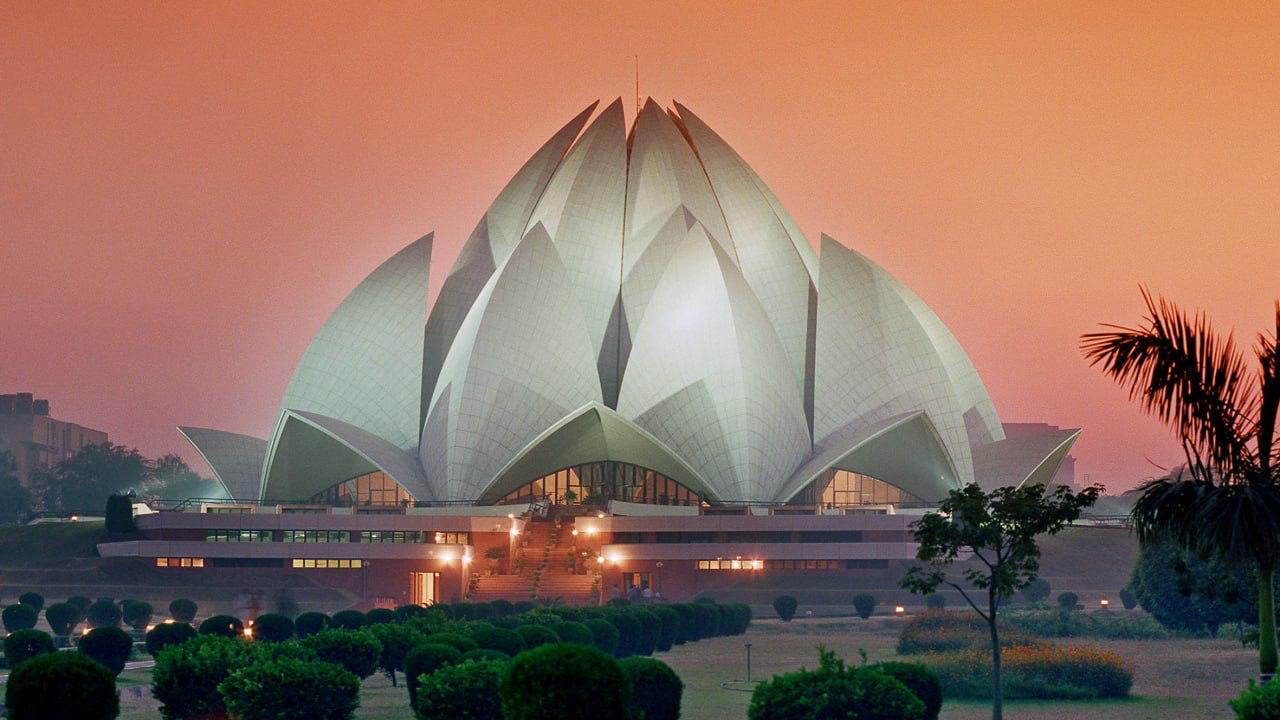
In a city as religiously and culturally diverse as Delhi, the Lotus Temple stands out because it was built to welcome everyone. The Lotus Temple was opened to the public in December 1986. Nine doors provide access for visitors to its large central prayer hall, a place where there is no cantor, clergy, priest, pulpit, or compulsory ritual. Individuals may sit in silence, pray, meditate, or listen to readings drawn from various sacred traditions. The official website of the Bahá’í House of Worship in New Delhi describes the temple as a place that embodies the principle of the oneness of humanity and invites people of every racial, religious, and national background to pray and meditate within its grounds.[1]
The Lotus Temple is a Bahá’í House of Worship, and Bahá’í temples are founded on the principle that worship should be open to all people regardless of religious identity.[2] The nomination dossier submitted to the UNESCO World Heritage Centre for the Bahá’í House of Worship in New Delhi also notes that the temple is dedicated to silent prayer and meditation, and that raising one’s voice is either uncommon or restricted to very specific occasions. In the Bahá’í Faith there is no formal clergy and no obligatory rituals, and multi-faith devotional programs consist of readings and recitations from the sacred texts of the world’s major religions.[3]
For this reason, the Lotus Temple is not merely an impressive architectural monument; it is also a public statement about coexistence. Its structure suggests that different paths can lead to a shared space. Its interior conveys the idea that human dignity does not require hierarchy, coercion, or sectarian control. Its openness demonstrates that believers, nonbelievers, seekers, and visitors can gather in a common contemplative environment without being required to ignore their differences.
The Lotus Temple is also significant for Iran and Iranians in several respects. The building was inspired by a faith that originated in Iran. Bahá’u’lláh, the founder of the Bahá’í Faith, was an Iranian born in Nur, Mazandaran, in 1817. The architect of the temple, Fariborz Sahba, is likewise Iranian and a graduate of Iranian universities. Furthermore, the lotus flower is an ancient and important symbol in Iranian culture and appears prominently in the reliefs of Persepolis.
In addition, like India, Iran is home to a diverse range of belief communities, including Muslims of different traditions, Christians, Jews, Zoroastrians, Bahá’ís, dervishes, Sufis, secular citizens, agnostics, and nonbelievers. However, many of these communities face pressure, exclusion, or repression. The Bahá’í community in particular continues to lack official recognition under Iran’s current constitutional framework and, according to reports by the Bahá’í International Community, has been subjected to systematic and long-term persecution by the government.[4] The United States Commission on International Religious Freedom has also reported that Iranian authorities continue to target religious minority communities, including Bahá’ís, Jews, Christians, Sunnis, and other non-Muslim groups.[5] In contrast to Fariborz Sahba, who was able to attend university during Iran’s secular monarchy, many Bahá’í youth today are denied access to higher education because openly identifying as Bahá’í can prevent their admission.
The Lotus Temple offers a compelling case study. It demonstrates how a community can express its own values while simultaneously creating space for others. It also illustrates how architecture, ritual simplicity, and public accessibility can foster coexistence without confrontation. From the perspective of civic education, the Lotus Temple represents a nonviolent, rights-based, and culturally meaningful example of how societies can cultivate empathy, respect, and solidarity among different belief communities.
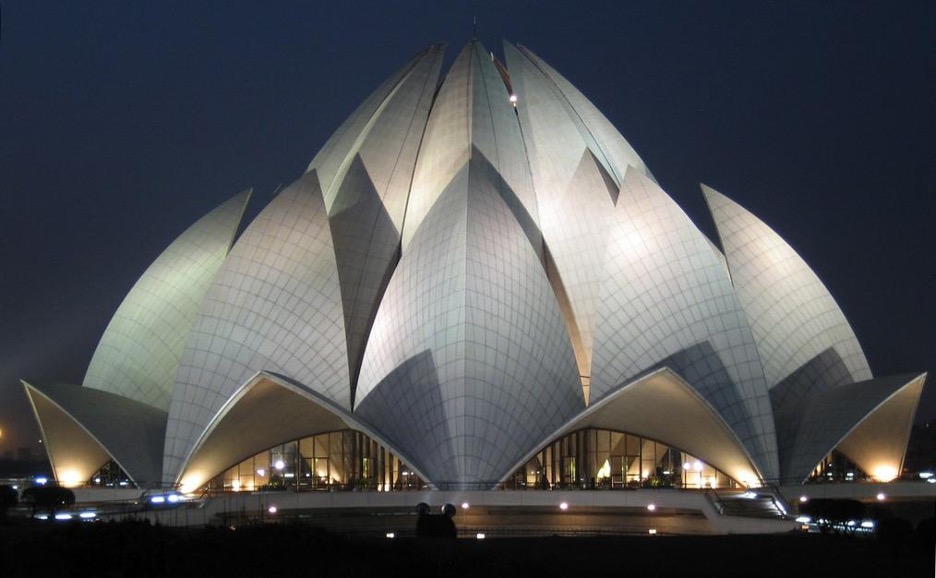
However, the Iranian architect of the building, Engineer Fariborz Sahba, and the Bahá’í community of India were determined to see it built. For them, the structure held a very special significance. Sahba understood that India was a society characterized by immense religious and cultural diversity, as well as a history of religious violence and social divisions. Inspired by the teachings of the Bahá’í Faith, he sought to create a house of worship whose doors would be open to all people.
He therefore searched for a symbol that could represent the building without being confined to any particular religion, while at the same time embodying a sense of unity and shared symbolism among different groups of people. The lotus flower was the symbol he found throughout the culture and architecture of India, as well as in many of the country’s religions and communities. Thus, the Lotus Temple was born.
Vision and Mission
The Bahá’í Faith has established several Houses of Worship around the world, including in Chile, Germany, the United States, and Australia. The central idea behind all of these structures is that people of every faith and background should be able to enter them. This concept stems from a fundamental principle of the Bahá’í Faith: the essential unity of all humanity. The vision embodied in the Lotus Temple is likewise the oneness of humankind. This concept occupies a central place in Bahá’í thought and is reflected not only in its teachings but also in the physical design and public function of the temple.[6]
The official website of the Bahá’í House of Worship in New Delhi describes the temple as a collective center for the community, built to promote love and fellowship and to embrace all people as equals. This vision is particularly significant because it is not merely an expression of belief; it is also embodied in the experience of visitors. Hindu, Muslim, Christian, Jewish, Sikh, Bahá’í, secular, and nonreligious visitors can all enter the same hall, sit together in shared silence, and enjoy equal dignity. The hall contains very few religious symbols. At the apex of its ceiling arch is a symbol known in Bahá’í thought as the Greatest Name of God. Moreover, because the interior is circular, it does not privilege any particular direction of prayer, allowing individuals who pray facing different directions to do so without difficulty.
The specific mission of the Lotus Temple is also reflected in its structure as a house of worship rather than a religious institution. The Bahá’í community of India presents the temple as a place that unites worship and service, while its nine entrances symbolize both the unity of religions and the idea that the divine messengers or manifestations of God ultimately serve as gateways to a single truth.[7] This symbolic language is especially valuable in pluralistic societies because it reinterprets religious differences not as threats but as diverse pathways to spirituality. This is something that contemporary Iranian society may particularly need, especially as the number of individuals who no longer identify as Muslim appears to be increasing.
The mission of the Lotus Temple also carries broader civic significance. Although the temple is not an advocacy organization in the conventional sense, its message has public implications. It calls upon every community to recognize the dignity of others and encourages believers to understand that safeguarding their own freedom of worship requires protecting the freedom of others as well. By demonstrating that sacred space need not be exclusionary, the temple also creates room for nonbelievers and religious minorities. In this sense, the Lotus Temple represents an idealistic vision whose ultimate success depends on whether it is understood and embraced by the wider public.
A culture of coexistence cannot be built solely through the resilience of communities facing discrimination or pressure. It also requires majority and minority communities, religious leaders, secular thinkers, educators, families, and civil society actors to defend one another’s dignity. The mission of the Lotus Temple can provide a symbolic foundation for such mutual recognition and shared respect.
Objectives and Functions
As noted earlier, the primary purpose of the Lotus Temple is to provide a shared space for prayer, meditation, reflection, and spiritual unity. Unlike many religious buildings, the temple was not designed to distinguish between “insiders” and “outsiders.”[8] Rather, it is founded on the principle that anyone may enter. Distinctions based on group membership and exclusion are of considerable importance in sociological studies. Many communities divide people into those who belong and those who do not. For this reason, scholars are interested in understanding why people are inclined toward such distinctions and how they construct boundaries between “us” and “them.” Various theories have been proposed to explain this tendency, but there is little disagreement that many societies actively maintain such divisions. In the concept and design of the Lotus Temple, however, an effort has been made to diminish, or even erase, the boundary between insiders and outsiders.
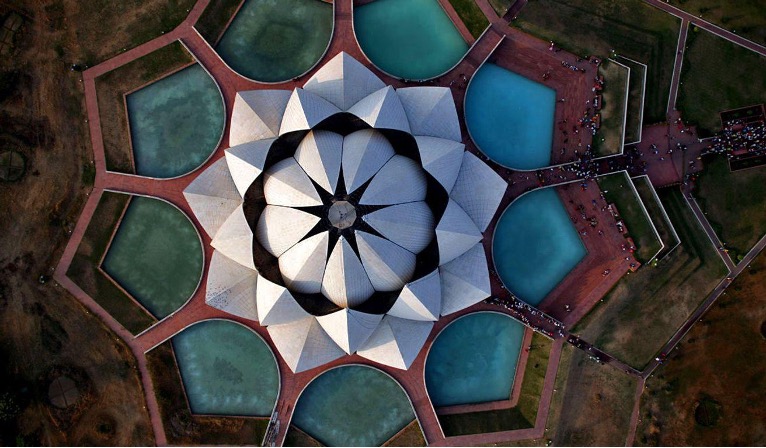
One of the temple’s objectives is to normalize religious diversity. By allowing people of different beliefs to gather within a shared contemplative space, the temple transforms diversity from an abstract concept into a lived experience. Visitors do not need to agree on theological questions, perform the same rituals, or identify with the Bahá’í Faith. Their shared action is simply one of presence: sitting together in silence, praying, or reflecting.[10]
Another objective is to remove barriers that commonly contribute to the formation of religious hierarchies. In the Bahá’í Faith, there is no formal clergy and no compulsory rituals. This aspect is significant because it reduces the concentration of interpretive religious authority in a single institution or office and creates a more open environment for ordinary individuals. It also decreases the likelihood that one religious identity will dominate the experience of others. This stands in clear contrast to many other religious traditions that designate certain individuals as holders of religious office, such as priests or clerics. The design of the Lotus Temple likewise ensures that no individual occupies a physically elevated position, such as a pulpit. There is also no distinctive religious dress or appearance that marks one person as spiritually superior to another.
A further objective of the building is to communicate the idea of unity through architecture. The temple’s nine-sided design and its nine entrances are widely associated with inclusiveness and the Bahá’í principle of unity.[11] The Bahá’í community of India explains that these entrances symbolize the unity of religions and the belief that diverse spiritual paths can be understood as gateways leading toward a single truth.
Another objective is to provide a symbolic language that carries meaning within the local cultural context. The lotus flower occupies a profound place in the cultures and religions of India and evokes a variety of meanings within Hindu, Buddhist, Jain, and other South Asian traditions. Choosing this form, rather than a narrowly sectarian symbol, makes the building understandable and welcoming to a broad range of communities and conveys the idea that the space belongs to the wider society. The modern aesthetic interpretation of the lotus has also ensured that the structure does not resemble India’s traditional houses of worship. This is an important point, because if the Lotus Temple had resembled a mosque, a church, or a Hindu temple, people would have been less likely to perceive it as belonging to all humanity.
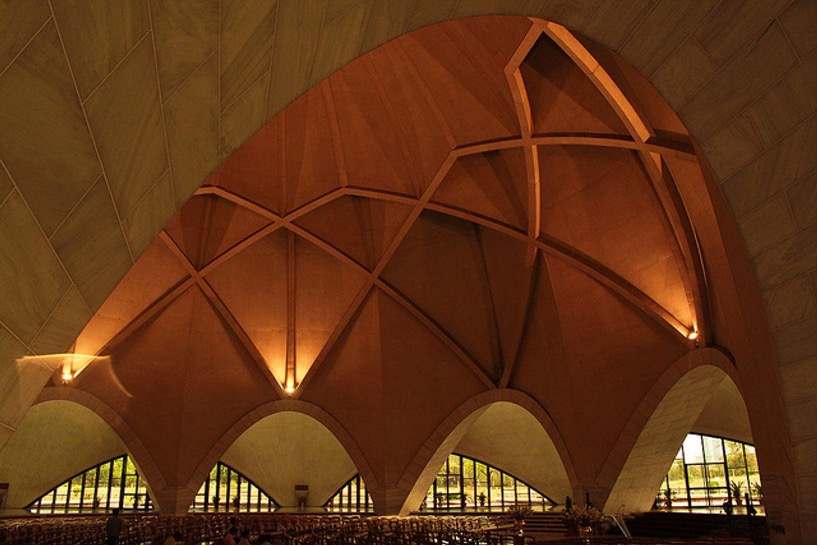
For Iranian civil society, these objectives offer a practical lesson: coexistence is more likely to flourish when shared spaces are designed intentionally. A room, website, educational program, memorial, or social gathering can either reproduce patterns of exclusion or communicate a message of welcome. The Lotus Temple demonstrates that design choices matter. Entrances, symbols, language, seating arrangements, rituals, and leadership structures all play a role in shaping whether people feel a sense of belonging or experience exclusion.
Leadership
At present, the general model of leadership within the Bahá’í community is based on elected bodies whose members are chosen through direct voting in periodic elections. These bodies are responsible for administrative affairs and operate at the local, city, and national levels, ultimately culminating in the highest institution of the Bahá’í administrative order, an elected body known as the Universal House of Justice. As noted earlier, no individual in the Bahá’í Faith is permitted to wear clerical attire comparable to that of priests or ayatollahs, nor may anyone claim authority to lead or direct the religion. Such claims are strictly prohibited within the Bahá’í community. The Bahá’ís of India likewise maintain an administrative structure that operates at both the national and local levels.
This model of governance without a clergy is reflected in the Lotus Temple itself. Individuals may serve as guides who assist visitors with entry, exit, or the scheduling of particular activities, but no one is permitted to preach to others. The temple does not rely upon a charismatic religious figure, a single preacher, or a dominant ritual authority. Instead, leadership is expressed through stewardship, architecture, hospitality, and the maintenance of an environment in which all visitors are treated equally.

This model has important implications for civic education. Leadership does not necessarily mean giving orders, exercising command, or enforcing ideological control. Rather, it can mean creating conditions in which others are able to reflect, gather, and encounter one another in safety. At the Lotus Temple, leadership is quiet yet purposeful: it is evident in the decision to leave the prayer hall free of sectarian imagery, in the inclusion of nine entrances, in the policy of welcoming all visitors, and in the effort to ensure that the symbols of one group do not dominate those of others. Although the Bahá’í community has its own administrative leadership, it does not regard the Lotus Temple as a place reserved exclusively for Bahá’ís.
This approach stands in clear contrast to discriminatory practices that have existed in Iran since the 1979 Revolution. In environments marked by repression, trauma, and distrust, leadership may require the creation of safe spaces. Civic leadership can involve facilitating dialogue, translating ideas across communities, protecting vulnerable participants, documenting narratives, building trust, and designing environments in which diverse groups can meet one another without fear.
Community and Environment
Throughout India, there are many houses of worship in addition to the Lotus Temple. Delhi itself is a dense mosaic of religious sites, languages, communities, and histories. Within such a setting, the openness of the Lotus Temple gives it a distinctive civic role. It is not merely a Bahá’í space; rather, it functions as a public place where many non-Bahá’í visitors experience a form of shared spiritual citizenship.
The level of public participation associated with the temple has been remarkable. According to the UNESCO World Heritage Centre, by April 2014 the Lotus Temple had received more than 100 million visitors, making it one of the most visited landmarks in India. Whether visitors come because of its architecture, tourism appeal, prayer, curiosity, silence, or photography, their presence reinforces the temple’s role as a shared civic and spiritual symbol.
The physical environment of the temple also supports this message. The structure is surrounded by gardens and reflecting pools that help prepare visitors for quiet reflection. The pools were designed in part to create a more moderate microclimate around the building. Moreover, situating the temple within a garden allows visitors to distance themselves from the routines of everyday life as they move through the green landscape, promoting a greater sense of mental and emotional calm. Such an atmosphere may also contribute to acceptance of others, since coexistence is not solely an intellectual matter but also involves emotional and sensory dimensions. Calmness, beauty, silence, and openness can reduce defensiveness and make people more receptive to difference.
Message and Activities
The central message of the Lotus Temple is that humanity can share sacred space without erasing its differences. This message is conveyed through the architecture itself, through the way visitors engage with the site, and through the principles governing worship within it.
From an architectural perspective, the temple’s most prominent message is unity through inclusion. The structure is composed of lotus-like petals that form nine sides and nine entrances leading into a central hall. These nine entrances symbolize the unity of religions and the idea that diverse spiritual traditions ultimately serve as gateways to a single truth.
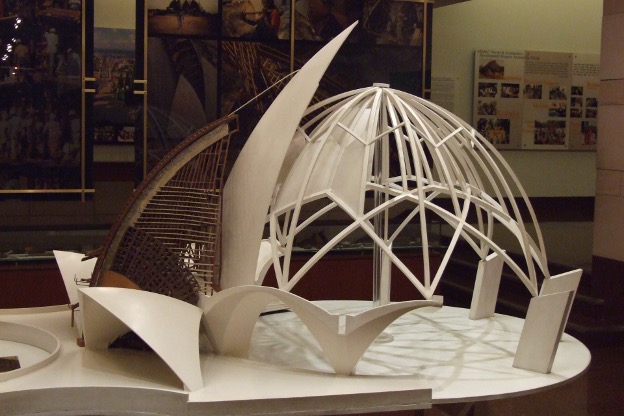
The use of the lotus symbol is especially significant. Rather than relying on a narrowly sectarian emblem, the temple employs a symbol that carries deep associations with purity, spiritual awakening, and beauty across a variety of Indian religious traditions. This choice allows the building to appear firmly rooted in its local cultural context while simultaneously conveying a universal message. The temple does not ask Indian society to set aside its religious diversity; instead, by drawing upon a shared cultural symbol, it invites different communities into a broader conversation about unity. According to the broader concept behind Bahá’í Houses of Worship, the temple and its surrounding institutions are also intended to serve the public through charitable, educational, and social services. In this sense, the building functions as a center around which other public-oriented activities may develop, including initiatives aimed at supporting the poor or providing education to disadvantaged groups.

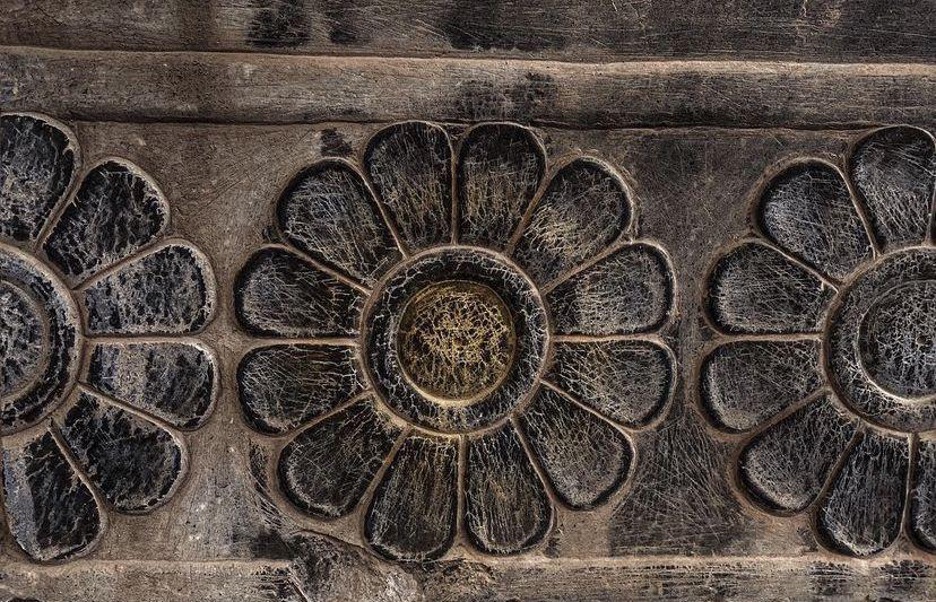
The lotus symbol extends beyond the Lotus Temple and appears throughout the religious traditions of the Indian subcontinent and beyond. In Hindu tradition, the deities Vishnu and Lakshmi are often depicted standing upon a pink lotus. The Buddha is likewise frequently portrayed seated on a lotus throne. In some Indian artistic traditions, both Zoroaster and Mani have also been associated with the lotus flower. Beyond South Asia, the lotus held important symbolic value in ancient Iran as well. At Persepolis, lotus motifs are among the most prominent decorative elements in the stone reliefs, and royal figures are often depicted holding lotus flowers in their hands.
Shared spaces for worship have not been common throughout history. In fact, they have been relatively rare. Some religious traditions include interpretations that encourage their followers to maintain distance from those who do not share their faith. Yet shared public spaces can reduce fear. Many societies condition individuals to view others through the lens of stereotypes, whereas common spaces create opportunities for different kinds of encounters, not as confrontations with perceived threats, but as interactions among fellow human beings. The open-door model of the Lotus Temple demonstrates how architecture and hospitality can soften the boundaries that separate communities.
One of the key lessons that can be drawn from the Lotus Temple is that inclusion must be implemented, not merely proclaimed. The temple’s nine entrances, absence of clergy, lack of sectarian imagery, and inclusive devotional practices all communicate a message of welcome. These choices are practical rather than merely symbolic, and they influence how people behave and how they feel within the space.
Civic initiatives in Iran could draw inspiration from this lesson by creating programs, online platforms, and social spaces where religious minorities, Muslims, secular citizens, women, and nonbelievers can participate without fear of humiliation or coercion. Achieving such a vision, however, would require convincing, or compelling, the government to respect the freedom of assembly and association of people from all intellectual and ideological backgrounds rather than suppressing it.
Another lesson offered by the Lotus Temple is that ancient cultural and religious symbols should not be casually discarded or destroyed. Unfortunately, history provides many examples of such losses. Symbols matter. The lotus is effective because it is beautiful, locally rooted, and spiritually inclusive. Iranian civic actors might similarly reflect upon symbols drawn from Iranian culture that convey dignity and emotional depth without being tied exclusively to any particular religion, symbols such as gardens, poetry, light, water, bridges, Nowruz, or hospitality. Such symbols can communicate pluralism in ways that feel authentic and culturally grounded rather than imposed or foreign.
The Lotus Temple may also serve as a source of inspiration for the idea that communities should voluntarily and actively defend the rights of all members of society rather than excluding others. Communities should not defend only their own rights. Muslims should defend the rights of Bahá’ís and Christians; Christians should defend the rights of Muslims and Jews; religious citizens should defend the rights of nonbelievers; secular citizens should defend the rights of religious believers; and, more broadly, everyone should defend the rights of everyone else. Such mutual defense is essential for building a society grounded in fundamental human rights.
A non-coercive approach to religion can support both democracy and coexistence. The Lotus Temple does not compel belief, require conversion, or impose rituals. Instead, it provides a space in which faith remains a voluntary matter. This distinction is particularly significant in the Iranian context, where state control over religion has often weakened both religious freedom and public trust. The Lotus Temple demonstrates that faith can enter the public sphere through service, beauty, and openness rather than through coercion.
The Lotus Temple is also an example of how communities living under conditions of discrimination can nevertheless contribute universal values to the wider world. Since its emergence, the Bahá’í community in Iran has faced severe restrictions. Yet one of the outcomes associated with that community, the Lotus Temple, demonstrates its contribution to global architecture and interfaith coexistence. In this way, the temple challenges the logic of repression: excluding minorities does not protect society; rather, it impoverishes it by depriving it of the creativity, service, and moral insight that those communities can offer.
What Can Be Learned from the Lotus Temple?
The Lotus Temple in Delhi is more than an architectural landmark; it is a living example of how physical space can teach coexistence. Its nine entrances, lotus-shaped form, open prayer hall, absence of clergy, and welcome extended to people of every faith, or no faith at all, embody a simple yet profound idea: human dignity does not depend upon uniformity.
For Iranian society, this case study is particularly valuable because it offers a constructive model. Rather than beginning with confrontation, it begins with hospitality. It does not ask individuals to abandon their beliefs; instead, it asks them to recognize the dignity of others. It does not erase religious identity, but creates a space in which multiple identities can coexist without domination.
The Lotus Temple demonstrates that empathy can be cultivated through shared experience, not merely through argument. Sitting in silence beside someone from a different faith community can itself become a lesson in civic life. The temple also illustrates that freedom of belief is most secure when communities defend one another rather than only themselves. The repression of Bahá’ís, Christians, Sunnis, Sufis, Jews, converts, secular citizens, women, or dissenting voices weakens society as a whole.
For activists, educators, and civil society actors in Iran, the Lotus Temple suggests several practical approaches: create spaces that are welcoming rather than restrictive; draw upon cultural symbols that foster unity; design programs in which religious and nonreligious participants can engage on equal terms; teach religious freedom as a shared safeguard rather than a privilege reserved for a single group; and encourage communities to defend one another in the face of discrimination and repression.
Ultimately, the Lotus Temple shows that coexistence is not a form of passive tolerance but an active design choice. It is a choice that must be embedded in institutions, language, architecture, education, and civic habits. In Delhi, that choice has taken the form of a lotus-shaped temple with nine open entrances. In Iran, its form may look different, but the underlying principle remains the same: a more peaceful society begins when every person has a dignified doorway through which they may enter.
[1]. Bahá’í House of Worship, New Delhi, “Home,” accessed June 14, 2026.
[2]. Encyclopaedia Britannica, s.v. “Bahāʾī Temple,” accessed June 14, 2026.
[3]. ubsxcco site – page: Bahá’í House of Worship at New Delhi.
[4]. Bahá’í International Community Representative Offices, “Current Situation,” Situation of Iranian Bahá’ís, accessed June 14, 2026.
[5]. United States Commission on International Religious Freedom (USCIRF), Iran Country Update (Washington, DC: USCIRF, July 28, 2025).
[6]. Bahá’í House of Worship, New Delhi, “Home,” accessed June 14, 2026.
[7]. The Official Website of the Indian Bahá’í Community, “Bahá’í House of Worship, New Delhi,” accessed June 14, 2026.
[8]. Government of NCT of Delhi, “The Lotus Temple,” District Magistrate Office, South East District Delhi, accessed June 14, 2026.
[9]. Architectuul, “Lotus Temple,” accessed June 14, 2026.
[10]. ubsxcco site – page: Bahá’í House of Worship at New Delhi.
[11]. The Official Website of the Indian Bahá’í Community, “Bahá’í House of Worship, New Delhi,” accessed June 14, 2026.
[12]. Architectuul, “Lotus Temple,” accessed June 14, 2026.
[13]. Joe Tash, “Architect Devoted to Creation of Spiritual Space,” The San Diego Union-Tribune, January 17, 2013.
[14]. ArchitectureZ, “Young Heritage – Lotus Temple Youngest in Heritage Race,” accessed June 14, 2026.
[15]. Encyclopaedia Britannica, s.v. “Lakshmi,” accessed June 15, 2026.
[16]. ECO Cultural Institute, “From Apadana to ECO: Analyzing the Lotus Symbol Across History and Diplomacy,” accessed June 14, 2026.
